Country of Origin: Dual-Regime Analysis for Customs and Export Control Jurisdiction

Article Summary
Country of origin is the determination of where a product was produced or substantially transformed for trade compliance purposes. It determines applicable duty rates and trade preference eligibility for customs purposes, sanctions exposure when goods originate in or transit through restricted jurisdictions, export control jurisdiction under the EAR including de minimis and FDPR applicability, and government procurement eligibility under the Buy American Act and Trade Agreements Act. Getting it wrong in any one of these dimensions can change whether a transaction is legal—not just what it costs.
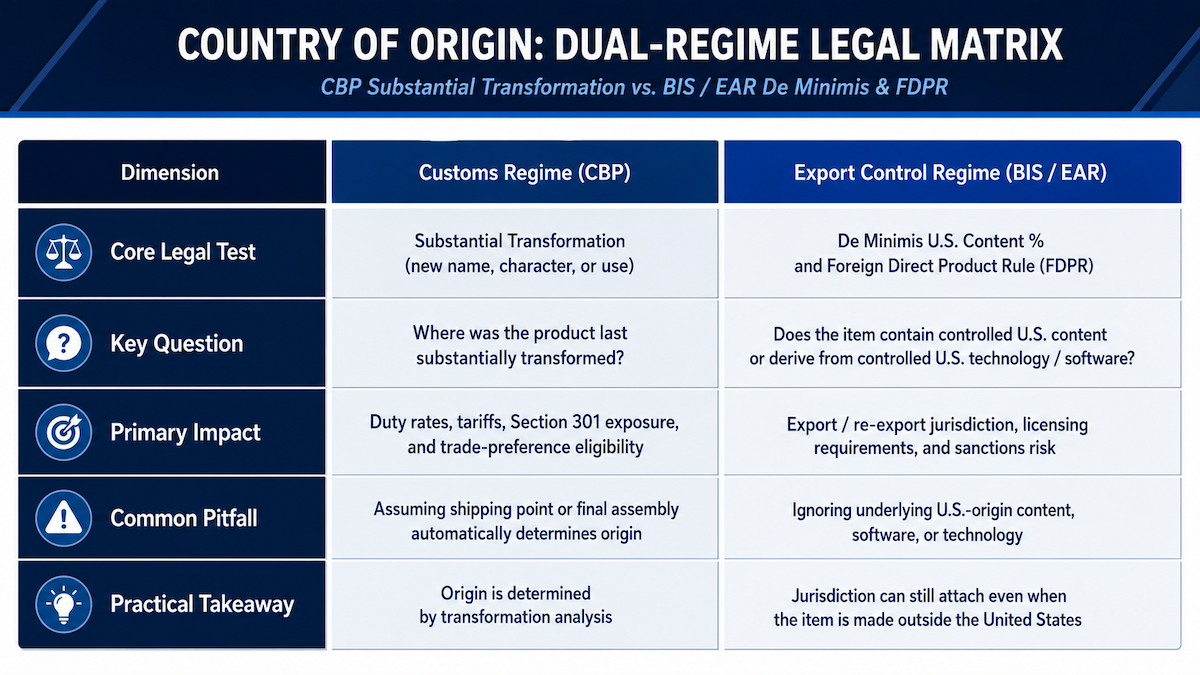
Substantial transformation is the U.S. customs standard for determining country of origin—a product's origin is the country where it was last substantially transformed into a new and different article of commerce with a distinctive name, character, and use. The last country of shipment is not the country of origin. A component manufactured in China, assembled in Vietnam, and shipped from Singapore may retain Chinese origin if the Vietnamese assembly did not constitute substantial transformation of the Chinese component into a new article of commerce.
Under the EAR, the origin of components, technology, and software determines whether a reexport or transfer of a finished product triggers U.S. licensing requirements. The de minimis rules establish thresholds above which U.S.-origin controlled content in a foreign-made product subjects that product to U.S. reexport controls. The Foreign Direct Product Rule extends U.S. jurisdiction to foreign-made items produced using U.S.-origin technology or equipment. Country of origin for customs purposes and jurisdiction for export control purposes are related but distinct analyses that must each be conducted independently.
OFAC sanctions programs prohibit transactions involving goods that originate in sanctioned countries regardless of where those goods are subsequently shipped or what form they take after processing. A product that incorporates materials or components originating in a sanctioned jurisdiction may be prohibited from import, export, or commercial transaction even if the finished product was manufactured in a permissible country. Sanctions exposure analysis must trace origin through the supply chain rather than relying on the shipment country as a proxy for origin.
The Buy American Act restricts federal procurement to U.S.-origin goods for domestic procurement. The Trade Agreements Act designates qualifying countries whose origin goods are treated equivalently to U.S.-origin goods for government procurement purposes. Agency-specific requirements may impose additional origin restrictions beyond these frameworks. Government contractors whose products incorporate components from non-qualifying countries may fail procurement eligibility requirements that their commercial compliance program was not designed to evaluate.
Origin determinations must be revisited whenever supply chains change—including new supplier relationships, new manufacturing locations, component substitutions, and processing arrangement modifications—because each of these changes can affect the substantial transformation analysis, the controlled content calculation, and the sanctions origin assessment that determine origin across all applicable regulatory regimes. An origin determination that was correct under a prior supply chain configuration may be incorrect under the current one, and the consequences of that change flow through customs duty liability, export control jurisdiction, sanctions exposure, and procurement eligibility simultaneously.
Most companies think of Country of Origin as a customs-and-duty question. It is, but it's also an export control question, a sanctions question, and increasingly a supply-chain-risk question. Getting it wrong doesn't just change the duty rate. It can change whether the transaction is legal.
Country of origin determines:
- Duty rates and trade preferences whether an import qualifies for USMCA, GSP, or other preferential programs, or whether it faces anti-dumping or Section 301 tariffs.
- Sanctions exposure whether the goods originate in or transit through a sanctioned country, which can prohibit the transaction entirely.
- Export-control jurisdiction under the EAR, the origin of components, technology, and software can determine whether a re-export or transfer triggers U.S. licensing requirements, including under the de minimis rules and the FDPR.
- Government procurement eligibility the Buy American Act, the Trade Agreements Act, and agency-specific requirements restrict which countries of origin are acceptable for federal contracts.
Where companies get this wrong:
- Assuming the last country of shipment is the country of origin.' It isn't. Origin follows the rules of substantial transformation, where the good was last substantially transformed into a new article of commerce. A component manufactured in China, assembled in Vietnam, and shipped from Singapore may still have a Chinese origin depending on the nature of the transformation.
bb Ignoring the export-control layer.' A product with U.S.-origin controlled content above de minimis thresholds may be subject to U.S. reexport controls regardless of where the finished product was made. Country of origin for customs purposes and jurisdiction for export-control purposes are related but not identical analyses.
bb Failing to document'. CBP, BIS, and contracting officers can all ask for your origin determination and the reasoning behind it. An undocumented determination is an indefensible one.
What to do:
- Treat country of origin as a multi-regime determination: customs, sanctions, export controls, and procurement all look at it differently.
- Map the origin of key components, not just the finished good, especially for items with potential U.S.-origin controlled content.
- Document the substantial-transformation analysis and the controlled-content calculation.
- Revisit origin determinations when supply chains shift. A new supplier or manufacturing location can change the answer.
CTP supports country-of-origin analysis across customs, export controls, and government procurement requirements. Talk with CTP →
Key Points
How do the four regulatory regimes that depend on country of origin each apply the concept differently, and what does a multi-regime origin analysis require that single-regime determination cannot provide?
Country of origin is not a single determination that satisfies multiple regulatory requirements—it is a concept that each regulatory regime applies through its own analytical framework, producing conclusions that may differ across regimes for the same product:
- Customs substantial transformation standard applying a different analytical test than the EAR's de minimis and FDPR jurisdiction rules—meaning that a product with U.S. customs origin in one country may simultaneously be subject to U.S. export control jurisdiction based on its controlled content regardless of customs origin — CBP's substantial transformation standard determines customs country of origin based on where a product was last transformed into a new article of commerce with a distinctive name, character, and use; the EAR's jurisdiction analysis determines whether U.S. export controls apply based on the percentage of U.S.-origin controlled content in the finished product and whether the product was made using U.S.-origin technology or equipment; these are analytically independent determinations that can produce different origin conclusions for the same product—a product with non-U.S. customs origin may nonetheless be subject to U.S. reexport controls based on its controlled content percentage, making multi-regime analysis a compliance necessity rather than an analytical redundancy.
- OFAC sanctions origin analysis tracing the geographic provenance of materials and components through supply chain tiers rather than applying the substantial transformation standard that determines customs origin — OFAC sanctions prohibitions apply based on the geographic origin of goods regardless of where they were subsequently processed; a product whose materials or components originated in a sanctioned jurisdiction retains its sanctions origin exposure even after substantial transformation in a third country that would change its customs country of origin; sanctions origin analysis must trace material and component provenance through supply chain tiers rather than relying on the substantial transformation conclusion that resolves the customs origin question.
- Government procurement origin analysis applying TAA-qualifying country and BAA domestic content standards that differ from both customs substantial transformation and export control de minimis calculations — The Trade Agreements Act and Buy American Act apply origin standards that evaluate whether a product's origin qualifies it for government procurement eligibility through criteria—TAA-qualifying country manufacture, BAA domestic content thresholds—that are analytically distinct from both customs substantial transformation and export control jurisdiction analysis; a product that satisfies customs origin requirements and export control jurisdiction compliance may nonetheless fail government procurement eligibility because its origin does not meet TAA or BAA standards, requiring a third independent origin analysis for government contractor customers.
- Anti-dumping and countervailing duty origin analysis creating additional customs-layer complexity for products whose manufacturing involves multiple countries with different AD/CVD exposure — Anti-dumping and countervailing duty orders apply to goods of specific country origin, and the origin determination for AD/CVD purposes—which CBP applies through its own scope and circumvention analysis frameworks—can differ from the standard substantial transformation determination that applies to general duty rate assignment; products processed through third countries specifically to circumvent AD/CVD orders face CBP circumvention investigations that apply more demanding origin analysis than standard substantial transformation, making AD/CVD origin a distinct analytical layer for products in affected categories.
- Multi-regime documentation requirement demanding that each regime's origin analysis is separately documented rather than relying on a single origin determination to satisfy all regulatory frameworks simultaneously — Because each regime applies origin through its own analytical framework and may reach different conclusions for the same product, compliance documentation must capture the origin analysis conducted under each applicable regime—customs substantial transformation, EAR controlled content, OFAC sanctions provenance, and procurement eligibility—as separate documented determinations rather than a single origin conclusion that is assumed to satisfy all regulatory requirements; undocumented origin determinations are indefensible across all four regimes simultaneously, and a documented determination that addresses only one regime's analytical framework provides no defense for the others.
- Supply chain change trigger requiring that all four regime analyses are revisited simultaneously when any supply chain change affects origin rather than assuming that a change affecting one regime's conclusion leaves others unchanged — A supply chain change that shifts manufacturing to a new location, introduces a new component supplier, or modifies a processing arrangement may simultaneously affect customs substantial transformation conclusions, EAR controlled content calculations, OFAC sanctions provenance assessments, and government procurement eligibility determinations; compliance programs that revisit only the most obviously affected regime analysis when supply chains change may miss origin conclusion changes in other regimes whose analytical sensitivity to the specific supply chain change was not immediately apparent.
How does the substantial transformation standard work in practice, and what analytical methodology does defensible customs origin determination require?
Substantial transformation is the most technically demanding origin standard in U.S. trade compliance—and the gap between a defensible analytical determination and a last-country-of-shipment assumption is the gap between CBP audit protection and duty liability exposure:
- Name, character, and use test application requiring product-specific analysis of whether the processing in each country produced a new article of commerce rather than a generic assessment of processing activity — Substantial transformation occurs when processing in a country produces an article with a new name, character, and use that differs from the input materials; applying this test requires product-specific analysis—evaluating what the input materials were, what processing occurred, and whether the output product has a distinctive name, character, and use that the inputs did not possess; generic assessments that characterize processing as substantial or insubstantial based on process type rather than product-specific name-character-use analysis produce origin conclusions that CBP challenges through its own product-specific analysis during audit or ruling review.
- CBP ruling research as the most authoritative external validation for substantial transformation conclusions where prior rulings on similar products provide direct guidance on how CBP applies the test to comparable manufacturing processes — CBP has issued thousands of rulings applying the substantial transformation standard to specific products and manufacturing processes whose research through the CROSS database provides the most directly applicable guidance for similar origin analyses; substantial transformation determinations that contradict established CBP ruling positions on comparable products and processes create audit exposure that ruling-aligned determinations avoid; CBP ruling research is a required step in defensible substantial transformation analysis rather than an optional validation exercise.
- Tariff shift methodology as an alternative origin standard applicable when trade preference programs or specific regulatory frameworks use tariff classification change rather than substantial transformation to determine origin — USMCA and certain other trade preference programs use tariff shift rules—requiring that processing in the preference region produce a change in tariff classification at defined heading or subheading levels—rather than the substantial transformation standard to determine qualifying origin; companies claiming trade preference benefits must apply the tariff shift rules applicable to the specific preference program rather than the substantial transformation standard that applies to general customs origin determination, and must document the tariff classification of inputs and outputs at the specificity the tariff shift rule requires.
- Multi-country processing analysis tracing the substantial transformation conclusion through each manufacturing stage when products are processed in multiple countries before reaching the final shipment country — Products manufactured through multi-country supply chains require substantial transformation analysis at each processing stage to determine where the decisive transformation occurred; analysis that evaluates only the final processing country without assessing whether earlier processing stages produced substantial transformation may identify the wrong origin country—particularly when significant manufacturing occurs in one country before less substantial finishing or assembly occurs in the final shipment country.
- Documentation standard capturing the name-character-use analysis, CBP ruling research, tariff shift calculation, and processing assessment that the substantial transformation conclusion relies upon — Customs origin documentation must capture the full analytical basis for the substantial transformation conclusion—including the description of input materials and their origin, the nature and location of processing, the name-character-use analysis applied, the CBP rulings researched, and the conclusion reached with its analytical rationale; documentation that records only the assigned country of origin without the analytical basis cannot be defended in a CBP audit, cannot support a binding ruling request, and cannot be updated when supply chain changes require origin re-determination.
- Formal CBP ruling requests for origin-critical products providing binding certainty that protects against retroactive duty assessment and AD/CVD circumvention findings for high-volume, high-duty-rate, or preference-critical product lines — For products whose origin determination is genuinely ambiguous under the substantial transformation standard, whose duty rate differential between origin alternatives is significant, or whose trade preference eligibility depends on origin accuracy, formal CBP ruling requests provide binding origin certainty whose protection against retroactive duty assessment and circumvention findings justifies the ruling request investment; binding rulings also provide the most authoritative documentation available for government procurement eligibility purposes when contractors must demonstrate origin compliance to procurement officers.How do the EAR's de minimis rules and the Foreign Direct Product Rule create export control jurisdiction based on origin, and what controlled content analysis do these rules require?
How do the EAR's de minimis rules and the Foreign Direct Product Rule create export control jurisdiction based on origin, and what controlled content analysis do these rules require?
The de minimis rules and FDPR extend U.S. export control jurisdiction based on the origin of controlled content in foreign-made products—creating compliance obligations that customs origin analysis does not address and that companies treating origin as a customs-only question systematically miss:
- De minimis threshold calculation requiring identification and valuation of U.S.-origin controlled content in foreign-made products to determine whether the threshold is exceeded and U.S. reexport controls apply — The EAR's de minimis rules establish percentage thresholds—generally 25% for most countries and 10% for countries in Country Group D:1—above which U.S.-origin controlled content in a foreign-made product subjects that product to U.S. reexport controls; applying the de minimis rules requires identifying which components in the foreign-made product are U.S.-origin and controlled under the EAR, calculating their value as a percentage of the total product value, and determining whether the percentage exceeds the applicable threshold for the destination country; companies that do not conduct this controlled content analysis for foreign-made products incorporating U.S.-origin components cannot determine whether U.S. reexport controls apply.
- FDPR jurisdiction analysis requiring determination of whether foreign-made products are the direct product of U.S.-origin technology or software or were produced by plant equipment that is itself the direct product of U.S.-origin technology — The Foreign Direct Product Rule extends U.S. export control jurisdiction to foreign-made items that are the direct product of U.S.-origin technology or software subject to the EAR, or that are produced by a plant or major component of a plant that is itself the direct product of U.S.-origin technology; FDPR analysis requires tracing the technology and equipment inputs to foreign manufacturing processes to determine whether U.S.-origin controlled technology or equipment was used in production—an analysis that customs origin determination does not address and that manufacturing companies frequently have not conducted for their foreign production facilities.
- Controlled content identification requiring classification of each U.S.-origin component in a foreign-made product under the EAR to determine whether it is subject to controls that count toward the de minimis calculation — De minimis calculation requires not only identifying U.S.-origin components but determining whether each is subject to EAR controls—components that are EAR99 do not count toward the de minimis threshold while components controlled under specific ECCNs do; this controlled content identification requires ECCN classification of U.S.-origin components at the component level, a classification exercise that most companies have not conducted for the U.S.-origin components they supply to foreign manufacturers or incorporate in foreign-assembled products.
- Supply chain documentation for controlled content analysis requiring that U.S.-origin component content and ECCN classification are tracked through multi-tier supply chains to support de minimis and FDPR determinations for finished products — Controlled content analysis depends on supply chain documentation that identifies which components are U.S.-origin, what their ECCN classifications are, and what value they represent in the finished product; companies whose supply chain documentation does not capture this information cannot conduct the de minimis calculation the EAR requires and cannot determine whether their foreign-made products are subject to U.S. reexport controls for specific destinations.
- Reexport control applicability determination connecting controlled content analysis conclusions to the specific licensing requirements and exceptions that apply to foreign-made products subject to U.S. jurisdiction — When de minimis or FDPR analysis concludes that U.S. reexport controls apply to a foreign-made product, the compliance analysis must then determine what specific licensing requirements or available exceptions govern reexport to the intended destination; this licensing determination follows the same framework that applies to direct U.S. exports—evaluating ECCN controls, destination country licensing requirements, end-user and end-use controls, and applicable license exceptions—but applies to a foreign-made product whose U.S. jurisdiction arises from its controlled content rather than its direct U.S. manufacture.
- Customs and export control origin analysis coordination ensuring that the different conclusions these two frameworks may reach for the same product are both reflected in compliance documentation and transaction processing — A foreign-made product may have non-U.S. customs origin under the substantial transformation standard while simultaneously being subject to U.S. export control jurisdiction under the de minimis rules or FDPR; compliance programs must coordinate customs and export control origin analyses to ensure that both conclusions are captured in the transaction record—preventing the customs origin conclusion from being incorrectly applied to the export control jurisdiction question or the export control jurisdiction conclusion from being overlooked because the customs origin analysis concluded non-U.S. origin.
How does country of origin create sanctions exposure, and what supply chain provenance tracing does sanctions origin analysis require?
Sanctions origin analysis is the regime where country of origin determination most directly determines transaction legality—because OFAC sanctions prohibitions apply based on geographic provenance in ways that neither substantial transformation nor export control jurisdiction analysis fully addresses:
- Sanctions provenance tracing through supply chain tiers required to identify sanctioned-country origin of materials and components that retain their sanctions exposure after processing in third countries — OFAC sanctions prohibitions apply to goods of sanctioned country origin regardless of where those goods are subsequently processed; a product incorporating steel, aluminum, textiles, or other materials that originated in a sanctioned country retains its sanctions exposure even after substantial transformation in a third country that changes its customs origin; sanctions provenance analysis must trace material and component origin through multiple supply chain tiers to identify sanctioned-country origin that substantial transformation has not eliminated for sanctions purposes.
- Specific sanctions program analysis determining which OFAC programs impose origin-based restrictions and what those restrictions specifically prohibit for goods with sanctioned-country content — Different OFAC sanctions programs impose different origin-based restrictions; some programs prohibit importation of any goods of sanctioned country origin regardless of processing, while others apply more targeted restrictions to specific product categories or transaction types; sanctions origin analysis must identify the specific OFAC programs applicable to the sanctions exposure identified and determine what specific transactions those programs prohibit rather than applying a generic sanctions origin prohibition without program-specific analysis.
- Transshipment country analysis distinguishing between goods that transit through sanctioned countries without acquiring sanctioned-country origin and goods that incorporate sanctioned-country materials or processing that creates origin exposure — Goods that transit through a sanctioned country en route to their destination do not automatically acquire sanctioned-country origin for sanctions purposes, but goods that incorporate sanctioned-country materials or that receive value-added processing in a sanctioned country may have sanctions origin exposure regardless of where they are subsequently shipped; transshipment analysis must distinguish between transit without processing—which generally does not create sanctions origin—and transit with material incorporation or value-added processing—which may create sanctions origin exposure depending on the specific program's restrictions.
- Supply chain mapping as the operational prerequisite for sanctions origin analysis requiring that tier-two and tier-three supplier origins are identified and evaluated rather than relying on direct supplier certifications as a complete compliance response — Sanctions origin exposure most commonly arises at tier-two and tier-three supply chain levels where direct suppliers source materials or components from sanctioned-country origins that are not disclosed in standard commercial documentation; supply chain mapping that identifies the geographic origin of materials through multiple supplier tiers provides the provenance visibility that sanctions origin analysis requires—direct supplier certifications that attest to the supplier's own origin compliance without addressing the supplier's supply chain origins provide incomplete assurance for sanctions purposes.
- Sanctions origin documentation supporting transaction compliance demonstration and regulatory inquiry response — Sanctions origin analysis must be documented with sufficient specificity to demonstrate to OFAC in an enforcement context that the organization conducted thorough provenance tracing and reached a supportable sanctions origin conclusion; documentation that records only the conclusion without capturing the supply chain mapping, tier-by-tier origin analysis, and program-specific restriction assessment that supported it cannot demonstrate compliance in an enforcement context where the adequacy of the origin analysis is itself under review.
- Ongoing supply chain monitoring for sanctions-country origin introduction through new supplier relationships, supplier ownership changes, and material substitutions that may introduce sanctioned-country content after initial origin analysis established a compliant supply chain — Sanctions origin analysis conducted at a point in time does not remain current as supply chains evolve; new supplier relationships, supplier acquisitions, and material substitutions may introduce sanctioned-country origin into supply chains that were compliant at the time of initial analysis; ongoing monitoring that detects supply chain changes with potential sanctions origin implications and triggers re-analysis when detected provides the continuous compliance assurance that point-in-time analysis cannot maintain across dynamic supply chain environments.
What government procurement origin requirements apply under the Buy American Act and Trade Agreements Act, and how should contractors structure origin compliance for federal procurement?
Government procurement origin requirements impose analytical frameworks that differ from both customs and export control origin standards—and contractors whose commercial compliance programs do not address procurement-specific origin requirements face eligibility failures that commercial trade compliance does not prevent:
- Buy American Act domestic content analysis requiring evaluation of whether products meet the component and manufacturing location thresholds that qualify them as domestic end products for federal procurement — The Buy American Act requires that federal procurement of goods use domestic end products—defined as articles manufactured in the United States from components at least a specified percentage of which are mined, produced, or manufactured in the United States; BAA compliance requires component-level origin analysis that identifies the domestic and foreign origin of each component and calculates the domestic content percentage against the applicable threshold; contractors whose products incorporate foreign-origin components without conducting this component-level analysis cannot confirm BAA compliance and risk procurement eligibility failures during contracting officer review.
- Trade Agreements Act qualifying country analysis determining whether products that do not meet BAA domestic content requirements qualify for the TAA exception based on manufacture or substantial transformation in a TAA-designated qualifying country — The TAA provides an exception to BAA restrictions for products manufactured in or substantially transformed in TAA-designated qualifying countries; TAA compliance requires identifying whether the product's country of manufacture or substantial transformation is among the designated qualifying countries—a list that includes most U.S. trading partners but specifically excludes China, Russia, and certain other countries—and documenting the manufacturing or substantial transformation analysis that supports the qualifying country determination; products manufactured in non-qualifying countries cannot satisfy the TAA exception regardless of their commercial origin documentation.
- Agency-specific procurement origin requirements imposing additional restrictions beyond BAA and TAA frameworks that vary by agency and contract type — Federal agencies may impose procurement origin requirements beyond the BAA and TAA through agency-specific regulations, contract clauses, and program-specific restrictions; defense procurement in particular involves additional origin requirements—including restrictions on specialty metals from non-qualifying countries under the Berry Amendment and country-of-origin restrictions for information and communications technology under Section 889; contractors must identify and comply with the full set of origin requirements applicable to each specific contract rather than assuming that BAA and TAA compliance satisfies all procurement origin obligations.
- Origin representation accuracy as a False Claims Act exposure requiring that procurement origin certifications reflect accurate origin analysis rather than commercial assumptions — Procurement origin representations are made under certification requirements whose inaccuracy can create False Claims Act liability in addition to contract compliance consequences; a contractor who certifies BAA or TAA compliance based on assumed origin rather than documented analysis faces both contract performance consequences—rejection of non-compliant products—and potential FCA liability for false origin certifications; procurement origin certifications must be based on documented origin analysis rather than commercial assumptions about where products are made.
- Supply chain change notification obligations requiring contractors to identify and disclose supply chain changes that affect procurement origin compliance before substituted components or manufacturing locations are incorporated into contract performance — Government contracts typically include supply chain change notification requirements that obligate contractors to disclose changes in component sourcing or manufacturing location that may affect procurement origin compliance; contractors who implement supply chain changes without evaluating their procurement origin implications and notifying contracting officers where required create both compliance failures for the specific contract and disclosure obligation violations that affect contractor responsibility determinations.
- CTP's multi-regime origin analysis capability supporting simultaneous customs, export control, sanctions, and procurement origin determinations for complex supply chain products — Country of origin compliance across all four applicable regulatory regimes requires analytical expertise that spans CBP substantial transformation standards, EAR controlled content analysis, OFAC sanctions provenance tracing, and BAA/TAA procurement eligibility determination; CTP's origin analysis capability covers all four regimes simultaneously—enabling contractors, importers, and exporters to obtain origin determinations that satisfy customs, export control, sanctions, and procurement requirements from a single coordinated analysis rather than through sequential single-regime determinations that may produce inconsistent conclusions.
How should companies structure ongoing country of origin management to maintain accuracy as supply chains evolve, and what governance infrastructure does origin compliance require across all four regulatory regimes?
Country of origin is not a one-time determination that remains valid through supply chain evolution—it is a compliance asset that must be actively maintained through governance infrastructure designed to detect and respond to the changes that affect origin conclusions across all four regulatory regimes simultaneously:
- Supply chain change management protocols that route new supplier relationships, manufacturing location changes, component substitutions, and processing modifications through multi-regime origin impact assessment before implementation — The most consequential origin compliance failures arise from supply chain changes implemented without origin impact assessment; governance protocols that require multi-regime origin analysis—customs substantial transformation, EAR controlled content, OFAC sanctions provenance, and procurement eligibility—as a prerequisite to supply chain change implementation prevent the origin conclusion changes that unreviewed supply chain modifications introduce across all four regulatory regimes simultaneously.
- Origin determination database maintaining current multi-regime origin conclusions for each product line with documented analytical basis, version control tracking changes over time, and defined review triggers for regulatory and supply chain developments — Origin compliance management requires a documentation infrastructure that maintains current multi-regime origin conclusions for each product, links those conclusions to the supply chain configuration on which they were based, versions the record when supply chain changes require re-determination, and triggers review when regulatory developments affect applicable origin standards; origin determination databases that capture only current conclusions without version history, supply chain configuration documentation, and review triggers cannot support the ongoing compliance management that dynamic supply chains require.
- Cross-functional origin governance integrating customs, export control, sanctions, and procurement compliance functions in a coordinated origin management framework rather than siloed single-regime origin determinations — Origin compliance across four regulatory regimes cannot be effectively managed by single-regime compliance functions operating independently; a coordinated origin governance framework that integrates CBP-focused customs compliance, EAR-focused export control compliance, OFAC-focused sanctions compliance, and procurement-focused contract compliance in a shared origin management process prevents the inconsistent regime-specific conclusions and documentation gaps that siloed origin management produces.
- Supplier origin disclosure requirements building supply chain provenance transparency into commercial supplier relationships through contractual disclosure obligations that provide the tier-two and tier-three origin data that internal analysis alone cannot generate — Multi-regime origin analysis depends on supply chain origin data that companies cannot independently generate for their entire supplier base; supplier origin disclosure requirements—contractually obligating suppliers to disclose the geographic origin of materials and components, to notify the buyer of supply chain changes affecting origin, and to provide origin documentation supporting procurement certifications—build the supply chain transparency that multi-regime origin analysis requires into commercial supplier relationships rather than treating origin data collection as a periodic compliance exercise.
- Periodic origin audit programs testing whether documented origin determinations remain accurate given current supply chain configurations and current regulatory standards across all four applicable regimes — Origin audit programs must test whether documented conclusions remain accurate rather than confirming only that origin determinations are documented; audit testing should compare documented supply chain configurations against actual procurement and manufacturing arrangements to identify configuration drift, evaluate whether regulatory developments have affected the analytical standards applicable to existing conclusions, and assess whether supply chain changes implemented since the last origin review have affected conclusions under any of the four applicable regimes.
- CTP's country of origin analysis, documentation support, and audit program design providing the multi-regime origin compliance capability that complex supply chain products require — Country of origin compliance across customs, export controls, sanctions, and government procurement requires coordinated analytical expertise whose combination most internal compliance programs have not assembled; CTP's origin analysis capability—spanning substantial transformation analysis, EAR controlled content calculation, OFAC provenance tracing, and BAA/TAA eligibility determination—provides the multi-regime origin compliance support that converts origin from a single-regime clerical assumption into a defensible multi-regime compliance foundation on which duty liability, export control jurisdiction, sanctions exposure, and procurement eligibility can all be confidently assessed.